
This article is general information, not legal advice. Laws differ between countries and change over time. If you’re building a commercial radio directory, talk to a lawyer who knows copyright and media law where you and your audience are.
If you’re planning a radio directory, one question comes up early: is it legal to list internet radio streams on your website? The short answer is that linking to publicly available streams is widely done and often lawful, but it isn’t risk-free, and the details matter. Here’s an overview of the key ideas, the court cases that shaped them, and good practices that keep your directory on solid ground.
Linking is not the same as rebroadcasting
A radio directory like one built with TuneSera points to a station’s own public stream. The audio travels from the station’s server to the listener’s browser. Your site lists the station and provides a player, but it doesn’t copy, store or relay the audio.
Re-streaming is different. If you capture a station’s audio and serve it from your own server, you’re effectively broadcasting it yourself, which would normally require your own music licences and the station’s permission. TuneSera doesn’t do this: it plays each station’s stream directly from the station.
Music licences belong to the stations
Stations that stream music generally need licences from music rights organizations in the countries where they operate. Examples include SoundExchange in the US, PRS for Music and PPL in the UK, and GEMA and GVL in Germany. Those licences are the station’s responsibility. A directory that links to the station’s official stream doesn’t take on the station’s licence, but it also can’t fix a station that doesn’t have one.
What the courts have said about linking
European Union
In Svensson (2014), the Court of Justice of the EU held that linking to works that are already freely available online doesn’t, by itself, reach a “new public”, so it isn’t infringement, unless the link gets around restrictions such as a paywall. In GS Media (2016), the court added that linking to content posted without the rightholder’s consent can infringe if the person linking knew or should have known it was unauthorized, and that this knowledge is presumed when the link is posted for profit.
United Kingdom: the TuneIn case
The case closest to radio directories is Warner Music v TuneIn. TuneIn aggregated a very large number of stations. The High Court (2019) found that linking UK users to stations licensed in the UK didn’t infringe, but linking them to stations licensed only abroad, or not licensed at all, did. The Court of Appeal upheld the decision in 2021, noting among other things that TuneIn played streams inside its own service and ran its own advertising.
The lesson for directory owners: who your audience is, and whether stations are licensed for that audience, can matter.
United States
US courts have often applied the “server test”, under which a site that links to or embeds content hosted elsewhere isn’t itself displaying it (Perfect 10 v. Amazon, 2007). Not every court agrees, so the position varies. Separately, the DMCA offers a safe harbor for “information location tools” such as directories, but only if the site meets its conditions, including acting quickly on valid removal notices.
Station names and logos
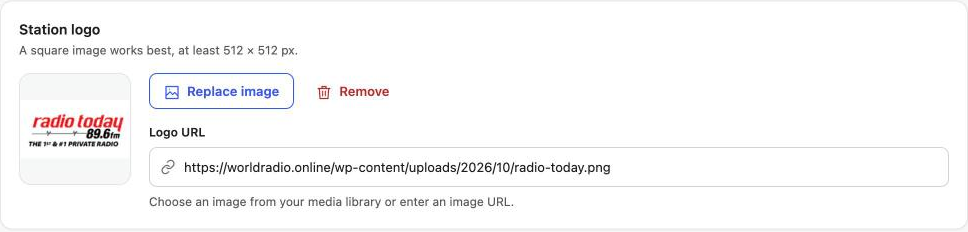
Station names and logos are often trademarks. Using them to identify a station in a directory is common, and in some places is protected as fair use when you use only what’s needed to identify the station and don’t suggest the station endorses your site. Avoid implying partnerships that don’t exist, and replace any logo a station asks you to remove. In TuneSera you can change any station’s logo in the station editor.
Good practices for a responsible radio directory
- Link only to official, publicly available streams, the ones the station itself publishes.
- Never bypass restrictions such as paywalls, logins or geoblocking.
- Respect station terms of use, and ask for permission when you can. Many stations are glad to be listed.
- Think about your audience’s country. Prefer stations licensed where your listeners are, especially if your site is commercial.
- Publish a clear contact and removal process, and act quickly when a station or rightholder asks you to remove a listing.
- Don’t re-host audio. Let the player stream directly from the station.
- Describe external connections in your privacy policy. TuneSera’s docs list every service it connects to.
How TuneSera fits in
TuneSera is built around linking, not rebroadcasting. The player streams from each station’s own server, now-playing information is read from the station’s stream by your server without sending visitor IP addresses, and you have full control over which stations you publish. If a station asks to be removed, move it to the Trash, or delete it permanently so a later import doesn’t bring it back.
For a full list of the services TuneSera connects to, see Privacy and external services.
Frequently asked questions
Do I need a music licence to run a radio directory?
A directory that only links to stations’ own streams generally doesn’t act as a broadcaster, so it usually doesn’t hold music licences itself. Rules vary by country, so check locally, especially if you run ads or charge for access.
Can a station ask me to remove its listing?
Yes, and you should respond quickly. Removing a listing promptly is good practice and, in some places, part of the conditions for legal protections.
Does running ads change anything?
It can. In the EU and UK, linking for profit can affect how courts assess knowledge of unlicensed content. Get advice before monetizing at scale.
Planning your directory? See 7 types of radio websites for ideas.
Sources
- Fieldfisher: CJEU on hyperlinks to freely accessible content (Svensson)
- Society for Computers and Law: GS Media hyperlinking judgment
- Warner Music v TuneIn, Court of Appeal judgment [2021] EWCA Civ 441
- RPC: Court of Appeal decision against a digital radio aggregator
- Mondaq: the server test and the TuneIn decision
- Ninth Circuit: DMCA safe harbor for information location tools
- GVL: licensing for web radio
- Davis+Gilbert: nominative fair use of trademarks


Join the conversation